

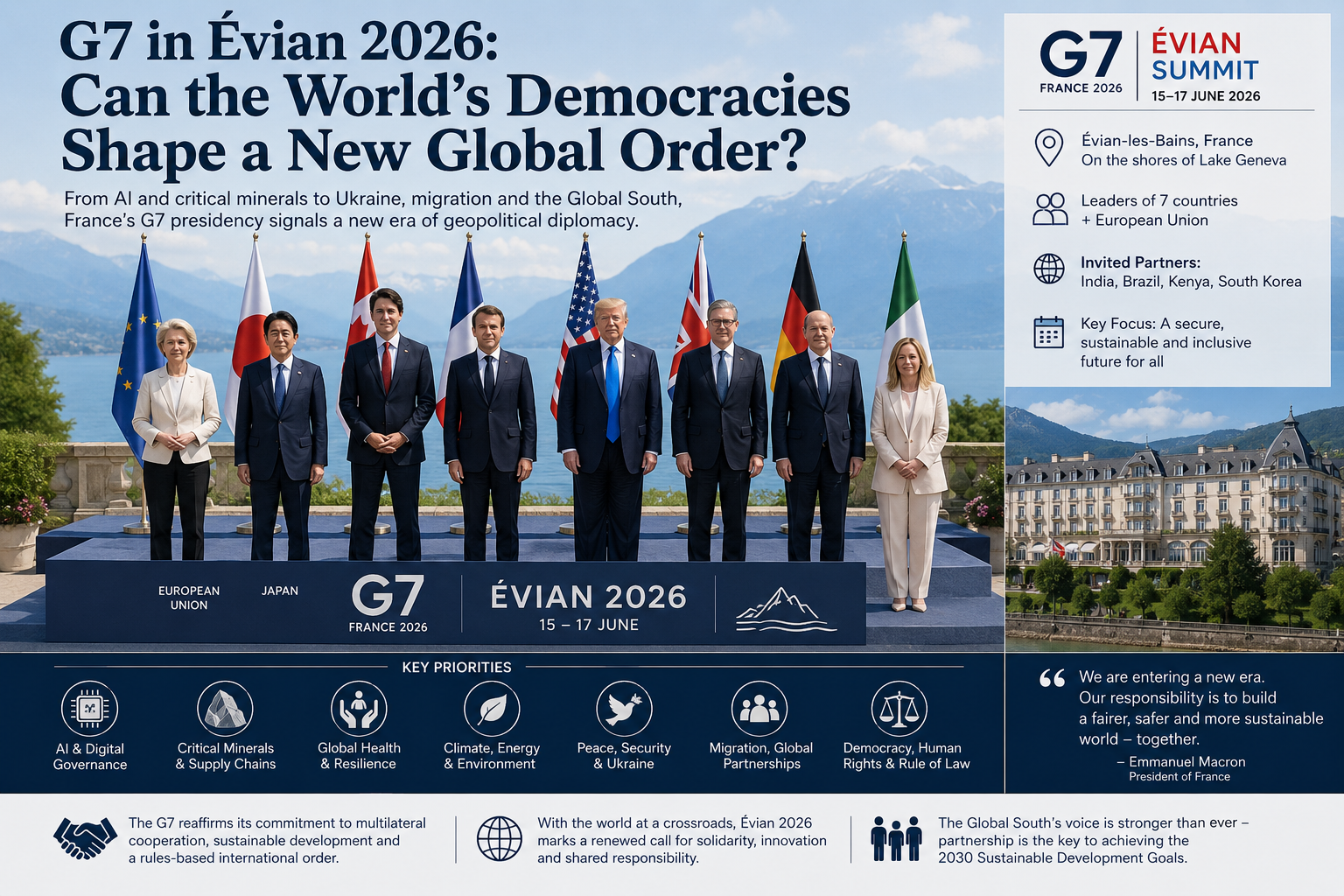
G7 in Évian 2026: Can the World’s Democracies Shape a New Global Order?
From AI and critical minerals to Ukraine, migration and the Global South, France’s G7 presidency signals a new era of geopolitical diplomacy.
By Geneva24 News | Feature
Nestled on the shores of Lake Geneva and framed by the French Alps, the spa town of Évian-les-Bains once again became the centre of global diplomacy as it hosted the 2026 G7 Summit from 15–17 June—23 years after welcoming the historic G8 Summit in 2003. Under France’s presidency, leaders of the world’s seven largest advanced democracies met at a time when international politics is being reshaped by war, economic fragmentation, artificial intelligence, and an increasingly influential Global South.
Unlike previous summits largely dominated by traditional security and economic issues, Évian 2026 reflected a world entering a different geopolitical era.
A Summit in a World of Uncertainty
The summit brought together leaders from France, the United States, Canada, the United Kingdom, Germany, Italy, Japan, alongside the European Union. France also invited leaders from India, Brazil, Kenya and South Korea, highlighting a growing recognition that today’s global challenges cannot be addressed without broader international partnerships.
President Emmanuel Macron described France’s presidency as an opportunity to return the G7 to its original purpose—finding coordinated responses to global economic instability while strengthening multilateral cooperation.
The “New Era” Agenda
Rather than focusing solely on traditional economic policy, leaders debated issues defining the coming decade.
Among the major outcomes were:
- New commitments to secure critical mineral supply chains, seen as essential for electric vehicles, semiconductors and clean energy.
- Joint initiatives promoting a safer digital environment for children amid growing concerns over AI-powered platforms and online harms.
- Discussions on artificial intelligence governance, balancing innovation with regulation.
- Continued coordination on Ukraine, Middle East security and broader geopolitical stability.
- Stronger cooperation against drug trafficking, migrant smuggling, organized crime and violent extremism.
- Renewed calls for balanced and resilient global economic growth.
The summit demonstrated that economic security, digital transformation and geopolitical stability are now inseparable.
Why Évian Matters
Évian is not just another summit venue.
It hosted the famous 2003 G8 Summit, remembered for debates over the Iraq War and the early rise of globalization protests.
Twenty-three years later, the challenges have changed dramatically.
Instead of debating globalization itself, leaders now confront:
- Fragmented supply chains
- Artificial intelligence
- Climate resilience
- Critical minerals
- Cybersecurity
- Strategic competition between major powers
- Rising influence of emerging economies
The return to Évian symbolizes how global diplomacy has evolved from managing globalization to managing geopolitical fragmentation.
Security Like Never Before
Hosting one of the world’s most powerful political gatherings required an unprecedented security operation.
France deployed around 16,000 security personnel, including police, military units, cyber specialists, bomb disposal teams, helicopters and drone operators. Security measures extended across the French-Swiss border, affecting transport throughout the Lake Geneva region.
Swiss authorities also reinforced border controls and coordinated closely with France, reflecting the increasingly cross-border nature of modern security threats.
Beyond the G7: The Global South Steps Forward
One of the most noticeable changes in Évian was the growing role of emerging economies.
With invited leaders from India, Brazil, Kenya and South Korea, discussions acknowledged that solving global challenges—from health and energy to technology and climate—requires broader international cooperation.
This shift mirrors wider debates within the United Nations, where developing nations increasingly seek greater influence over global governance institutions.
AI Becomes a Diplomatic Issue
Artificial Intelligence emerged as one of the defining topics of the summit.
Unlike previous years, AI was no longer treated simply as a technology issue but as a geopolitical challenge involving economic competitiveness, cybersecurity, misinformation and child protection.
Leaders endorsed initiatives promoting safer online environments for minors while exploring international cooperation on AI governance and responsible innovation.
Challenges Remain
Despite the broad agenda, the summit also reflected growing questions about the G7’s future.
As economic power shifts toward Asia and the Global South, analysts increasingly debate whether the G7 can continue shaping global policy on its own.
Some observers argue that institutions such as the G20, BRICS and regional alliances are becoming increasingly influential, making broader partnerships essential rather than optional.
Geneva’s Diplomatic Moment
Although the summit took place in France, nearby Geneva played a supporting diplomatic role.
Swiss authorities coordinated closely on security, while Geneva hosted several bilateral meetings and diplomatic engagements linked to the summit, reinforcing the city’s position as one of the world’s leading centres for international dialogue.
Looking Ahead
The Évian Summit illustrated that today’s global agenda extends far beyond traditional economic coordination.
Artificial intelligence, climate resilience, critical minerals, migration, digital safety, geopolitical conflict and cooperation with emerging economies now define international diplomacy.
Whether the G7 can continue adapting to this rapidly changing world remains an open question. Yet Évian 2026 demonstrated that even in an era of geopolitical rivalry, dialogue among major democracies remains central to addressing shared global challenges.