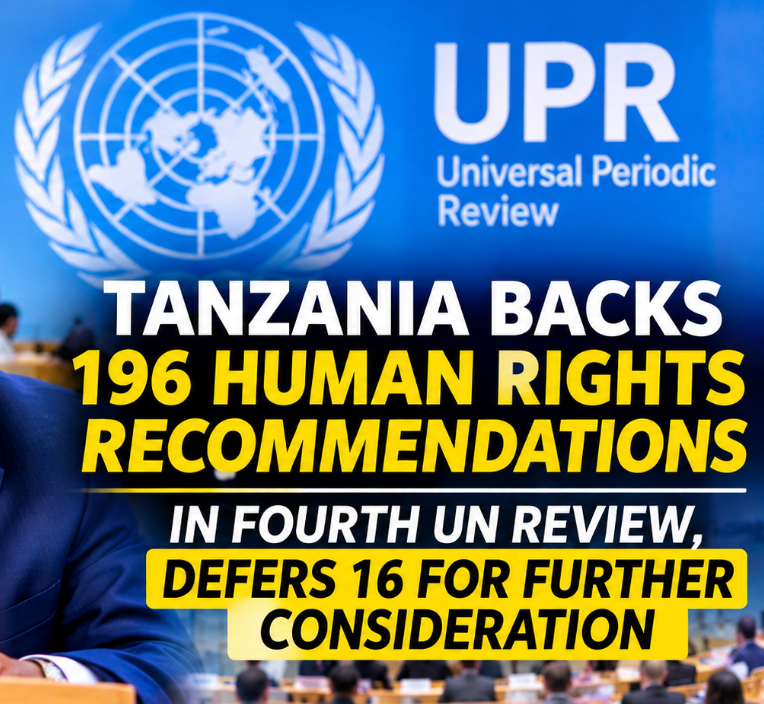
GENEVA, Switzerland — The United Republic of Tanzania has supported 196 of the 280 recommendations made during its fourth Universal Periodic Review (UPR) before the United Nations Human Rights Council, while taking note of 68 and deferring 16 for further consideration.
The positions were announced by the Minister for Constitutional and Legal Affairs, Hon. Abdallah Hamis Ulega, following Tanzania’s review on 5 November 2026 during the 53rd session of the UPR Working Group in Geneva.
The 196 supported recommendations represent 70 per cent of the total, while 24.3 per cent were noted and 5.7 per cent deferred.
The Government said it could not support certain recommendations because they were inconsistent with Tanzania’s traditions, customs, constitutional provisions, legal frameworks and national policy priorities. These included proposals concerning same-sex relations and abolition of the death penalty.
The 16 deferred recommendations require further examination of their legal, policy, economic and financial implications. Tanzania plans to consult the Judiciary, Parliament, civil society organisations and other relevant stakeholders before communicating its final positions, expected at the Human Rights Council in February 2027.
Democratic governance and civic space
During the review, Tanzania presented reforms undertaken since its previous UPR in 2021, when it supported 187 of the 252 recommendations received, including 20 in part.
The Government said President Samia Suluhu Hassan’s Four Rs philosophy — Reconciliation, Resilience, Reforms and Rebuilding — had guided efforts to strengthen democratic participation and political dialogue.
Consultations conducted by the Task Force on Multi-Party Democracy contributed to renewed engagement with political stakeholders and the lifting of restrictions on political rallies. The Government also lifted the suspensions of four newspapers.
Electoral reforms included the Independent National Electoral Commission Act, which introduced public applications, shortlisting and interviews for certain commissioner positions. The Presidential, Parliamentary and Councillors’ Elections Act also requires unopposed parliamentary and councillor candidates to obtain voters’ approval.
Civil society organisations participated in voter education and domestic election observation during the 2025 general elections. By 2026, more than 7,700 non-governmental organisations and 710 societies had been registered.
The Government also outlined legislative reforms and ongoing reviews involving the Media Services Act, Access to Information Act and Cybercrimes Act, including the removal of criminal defamation provisions.
Internet penetration was reported at 83.5 per cent, with authorities highlighting the importance of privacy, online safety and child protection as digital connectivity expands.
Addressing the violence surrounding the general elections of 29 October 2025, the Government described the events as deeply regrettable, acknowledging the loss of life and suffering experienced by families and communities.
A Presidential Commission of Inquiry, established on 18 November 2025, publicly presented its principal findings on 23 April 2026. Following its recommendations, a separate Criminal Investigation Commission was established to investigate possible criminal offences and establish individual responsibility.
The Government said it remained committed to establishing the facts and ensuring accountability through lawful processes.
International concerns over elections and civic freedoms
During the interactive dialogue, several participating countries raised concerns about the human rights situation surrounding the 2025 elections.
The United Kingdom expressed concern over reported excessive use of force by security forces and significant loss of life, calling for transparent and accountable investigations into alleged violations.
Norway also raised concerns about restrictions on civic and political space, reports of extrajudicial killings, enforced disappearances and arbitrary arrests.
Other delegations called for stronger protection of journalists, opposition politicians, human rights defenders and civil society organisations, alongside reforms to legislation affecting freedom of expression, peaceful assembly and association.
These recommendations formed part of the wider international dialogue on strengthening accountability, democratic institutions and fundamental freedoms in Tanzania.
Access to justice
Tanzania highlighted improvements in judicial infrastructure and access to legal services.
On Mainland Tanzania, the Government reported 26 High Court sub-registries across 25 regions, 15 Integrated Justice Centres, 137 District Courts and 962 Primary Courts. Zanzibar has also developed four smart courts.
The Mainland’s case backlog declined from approximately 10 per cent to 5 per cent, while average case determination time fell from 95 to 66 days. In Zanzibar, the backlog decreased from 43 per cent to 18 per cent.
More than 170,000 cases were concluded through digital and virtual court arrangements.
The Mama Samia Legal Aid Campaign reached approximately 7.9 million people, including more than four million women. Tanzania also translated 446 statutes into Kiswahili to improve public access to legal information.
Equality and protection
Women accounted for 39.3 per cent of Parliament in 2025 and 36.5 per cent of the Judiciary. The proportion of women holding land rights increased from 28.5 per cent in 2020 to 35 per cent in 2025.
Under its Second National Plan of Action to End Violence Against Women and Children, Tanzania has strengthened reporting mechanisms, survivor support services and community awareness programmes.
The Government also highlighted its National Assistive Technology Strategy, measures to expand inclusive education and access to public services, and the National Action Plan for Persons with Albinism, aimed at improving protection and access to healthcare, education and economic opportunities.
Access to essential services
Education financing increased from approximately TZS 5.6 trillion in 2022/23 to TZS 6.3 trillion in 2025/26.
The Government reaffirmed its commitment to fee-free basic education and programmes allowing students who previously left school to resume their studies, including girls who left because of pregnancy.
On Mainland Tanzania, the number of health facilities increased from 8,458 in 2022 to 10,044 in 2026.
Maternal mortality declined from 197 to 104 deaths per 100,000 live births on the Mainland, while Zanzibar recorded a reduction from 166 to 119.
Newborn mortality on the Mainland fell from 25 to 19 deaths per 1,000 live births. Antenatal care coverage reached 98 per cent, while facility deliveries increased from 83 to 98 per cent.
Regarding HIV prevention and treatment, the Government reported that 82.7 per cent of people living with HIV knew their status, 97.9 per cent were receiving antiretroviral therapy and 94.3 per cent had achieved viral suppression. Antiretroviral medicines remain free of charge.
The basic-needs poverty rate declined from 26.4 per cent in 2020 to 24.9 per cent in 2025. The Productive Social Safety Net supported approximately 1.36 million households, benefiting more than 5.1 million people.
Access to clean water reached 85.2 per cent in rural areas and 92.5 per cent in urban areas.
The Government also reported that more than 700 kilometres of the Standard Gauge Railway were operational and that the Julius Nyerere Hydropower Project had a generation capacity of 2,115 megawatts.
Electricity had reached all 12,318 villages on Mainland Tanzania, with national electrification reported at approximately 79.5 per cent.
Investments across productive sectors were said to have generated more than 4.2 million employment opportunities. Climate resilience measures included producing more than 167 million tree seedlings in 2025/26 and expanding access to clean cooking energy.
Priorities for implementation and international cooperation
The 196 supported recommendations cover a wide range of human rights priorities, including inclusive consultations on constitutional and electoral reforms, strengthening the administration of justice, accountable institutions and the protection of fundamental freedoms.
Other areas include gender equality, prevention of gender-based violence, child protection, addressing harmful traditional practices, disability inclusion and the protection of persons with albinism.
The recommendations also address equitable access to healthcare, safe drinking water, social protection and the conservation and sustainable use of natural resources.
Tanzania highlighted its cooperation with regional and international human rights mechanisms, including hosting the African Commission on Human and Peoples’ Rights at its 77th Ordinary Session in Arusha in 2023.
Minister Ulega thanked the President of the UPR Working Group, participating Member States, the Troika comprising Burundi, Ecuador and Viet Nam, and the UN Secretariat. He also acknowledged support from the UPR Voluntary Fund, the Office of the United Nations High Commissioner for Human Rights and the Commonwealth.
The Government said it would work with national stakeholders and international partners to implement the supported recommendations.
It identified human rights education for citizens and public officials, wider access to legislation in Kiswahili and the responsible use of technology in public services as priority areas for further cooperation under Tanzania Development Vision 2050.