
UN Human Rights Council to Hold Urgent Debate on Sudan Crisis as 500,000 Civilians Face Atrocity Risk
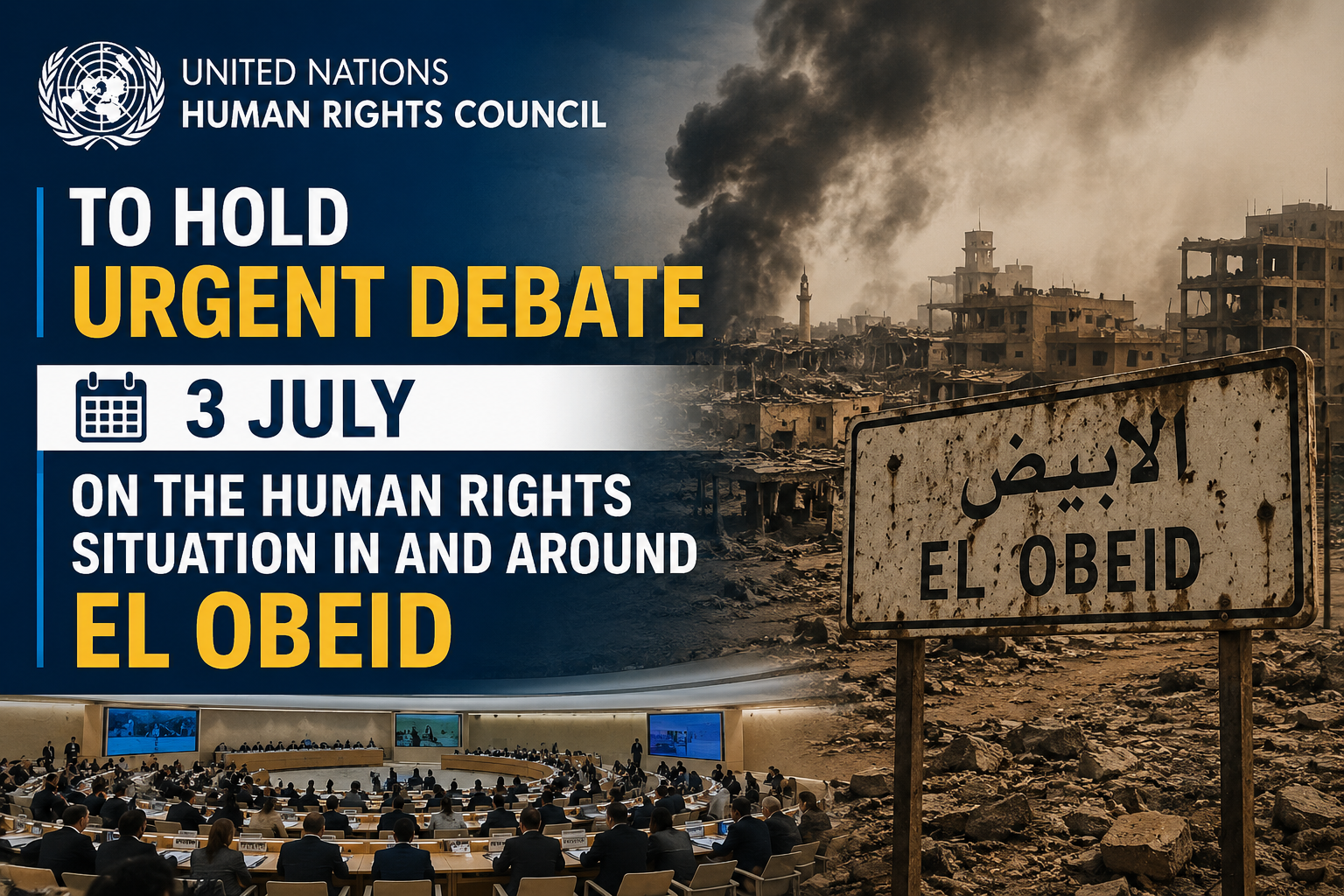
The United Nations Human Rights Council (UNHRC) will convene an urgent debate on Friday, 3 July, to address the rapidly deteriorating human rights situation in and around El Obeid, the capital of Sudan’s North Kordofan State, amid mounting concerns that hundreds of thousands of civilians face an imminent risk of large-scale atrocities.
The emergency discussion, scheduled to begin at 10:00 a.m. (CEST) at the Palais des Nations in Geneva, comes as international alarm grows over the humanitarian consequences of Sudan’s ongoing conflict. The session will be broadcast live on UN Web TV in all six official UN languages.
The debate was requested by a core group of countries—Germany, Ireland, the Netherlands, Norway, and the United Kingdom—which warned that the situation on the ground has reached a critical point.
According to the request submitted to the Human Rights Council, approximately 500,000 civilians are believed to be at risk as violence intensifies around El Obeid. The group highlighted reports of increasing drone attacks that have damaged essential civilian infrastructure, triggering severe shortages of fuel and clean water while leaving thousands of residents trapped under conditions resembling a siege.
“The threat of potential escalation on the ground requires urgent international attention,” the requesting countries stated, warning that civilians remain cut off from basic services and humanitarian assistance.
Draft Resolution Expected
As part of the urgent debate, the sponsoring countries are expected to introduce a draft resolution calling for action by the Human Rights Council. While the details of the resolution have not yet been released, it is anticipated to address civilian protection, humanitarian access, and accountability for alleged violations of international human rights and humanitarian law.
The Council adjusted the programme of work for its ongoing 62nd Regular Session to accommodate the emergency debate, underscoring the seriousness of the situation.
Unlike a Special Session, an urgent debate can be convened without requiring signatures from member states or formal notification procedures, allowing the Council to respond more rapidly to emerging crises.
Growing International Concern
Sudan has remained engulfed in conflict since fighting erupted in April 2023 between rival military factions, triggering one of the world’s largest displacement and humanitarian crises. Millions have been forced from their homes, while repeated attacks on civilians, healthcare facilities and critical infrastructure have drawn widespread condemnation from the international community.
The situation in El Obeid, a strategically important city linking western and central Sudan, has become increasingly precarious as fighting spreads across North Kordofan. Humanitarian agencies have warned that continued violence risks cutting off aid deliveries to large parts of the country.
Human Rights Council’s 13th Urgent Debate
Friday’s meeting will mark the 13th urgent debate convened by the Human Rights Council since the mechanism was established in 2006. Urgent debates are reserved for situations requiring immediate international attention and provide member states with an opportunity to examine rapidly evolving human rights crises and consider collective action.
Diplomats, UN officials, humanitarian organizations, and civil society representatives are expected to participate in the discussion, which is likely to focus on measures to protect civilians, ensure humanitarian access, and strengthen international monitoring of the conflict.
As the humanitarian crisis deepens, Friday’s debate is expected to place Sudan once again at the centre of international attention, with growing calls for stronger global action to prevent further civilian suffering and avert a wider catastrophe.
The urgent debate will be held on Friday, 3 July 2026, at 10:00 a.m. (CEST) in the Assembly Hall of the Palais des Nations, Geneva, and will be streamed live on UN Web TV.